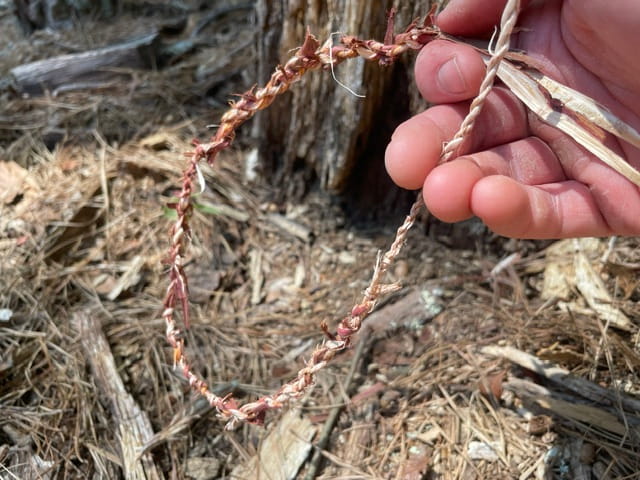
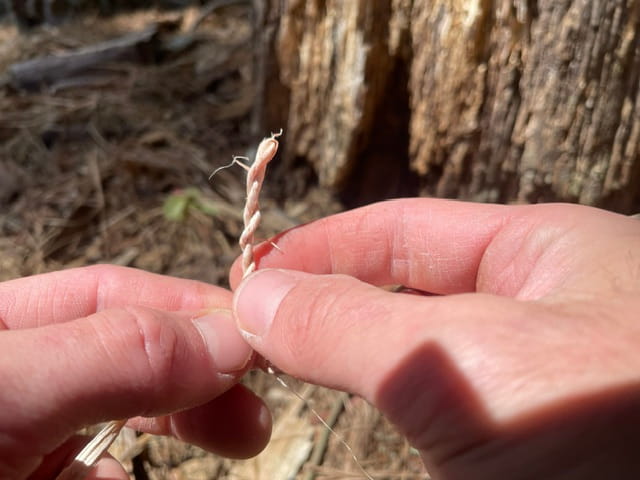
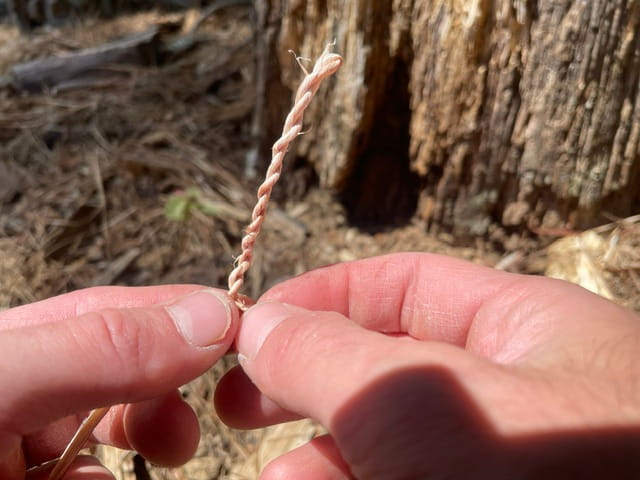
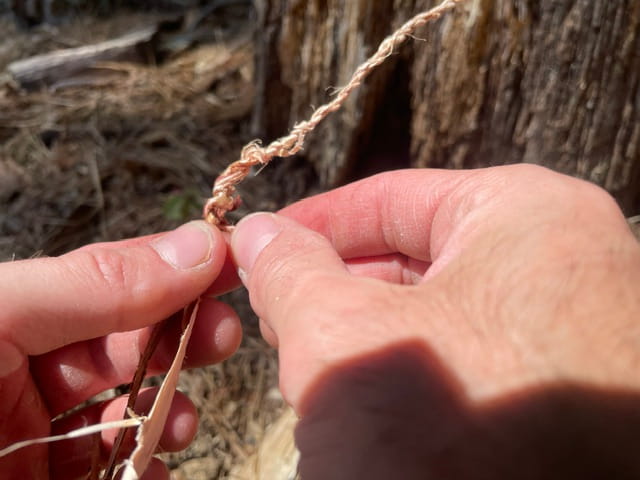
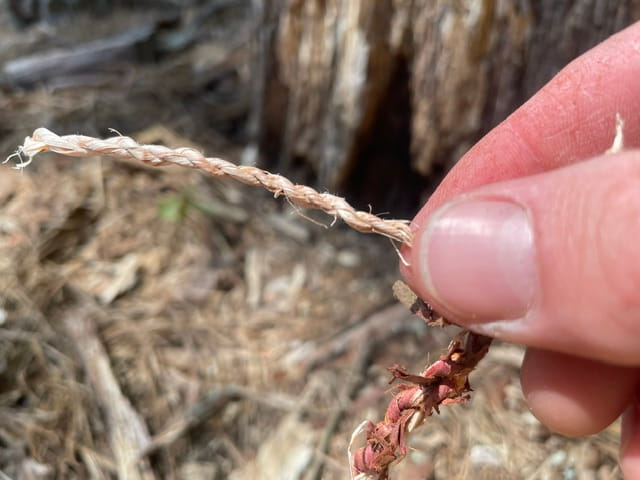
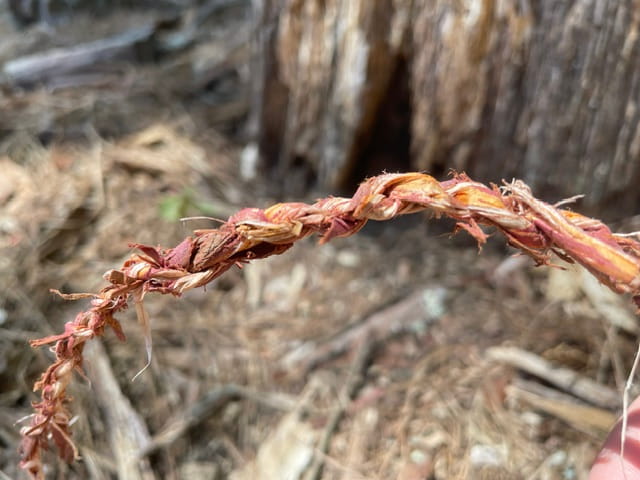
Some cordage I made in all of a few minutes in the yard with nothing but a downed cedar and a good knife.
“The best help that benevolence and philanthropy can give is that which induces everybody to help himself.” Calvin Coolidge.
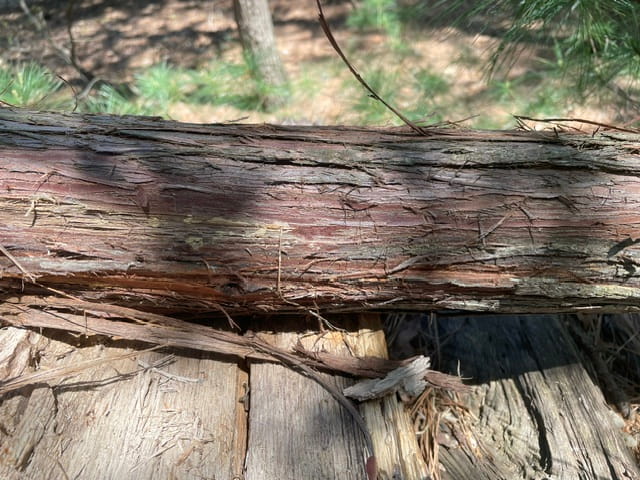
Pictured below is a trunk of an Atlantic White Cedar that came down here in a recent nor’easter under a snow load. I took the tree but rather than processing the entire trunk, left it whole so I could demonstrate how to make basic cordage with whatever you can gather out there. It just so happens that the white inner bark of Atlantic White Cedar is one of the best materials in my area for making cordage. It’s easy to work with and very strong, too.
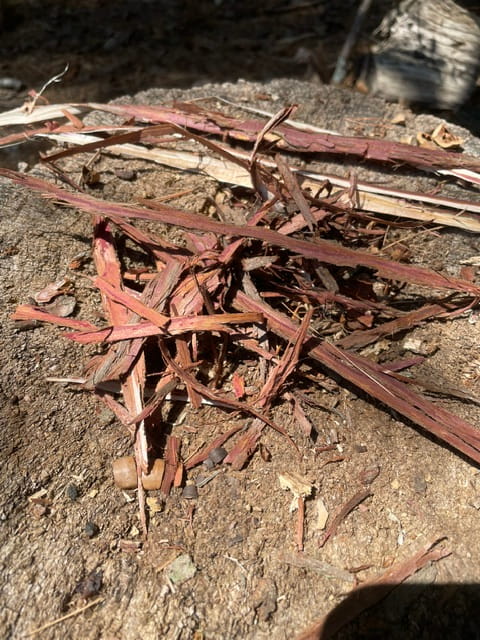
Atlantic White Cedar is an excellent tree to provide fibers from the bark for making cordage. You need the white inner bark, not the rust red outer stuff. It's too brittle. It makes good tinder, though, because it has a lot of oil.
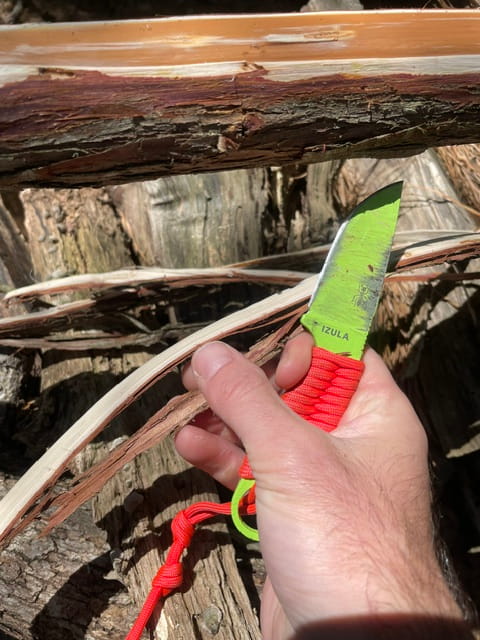
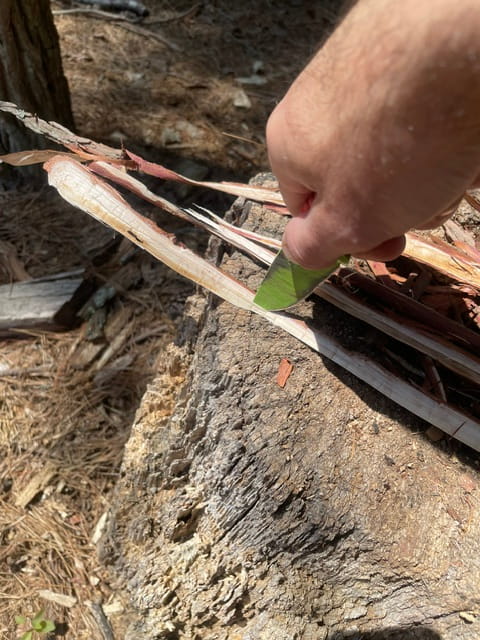
To make basic cordage, you will first need to harvest some strips of bark. Make sure you cut down all the way through the dark red outer bark and white inner bark, till you contact the cambium underneath. Using a draw cut with your knife as you can see in the image below, it’s fairly easy to shave off the margin. If possible, take the longest strips possible as this will make it easier for you to work with.
Once you have several strips of bark, you need to roll them between your hands, or pound them against a hard surface so as to make it easy to separate the outer and inner bark. The outer bark is brittle and does not make good cordage. Ideally you would strip it all off till all you were left with was the white inner good stuff.
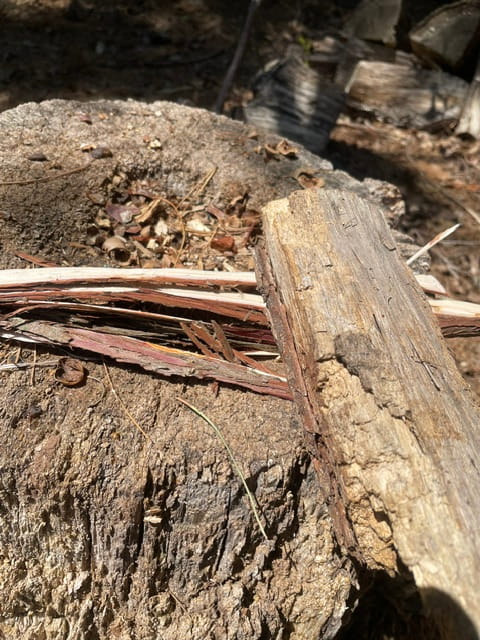
To make this easier, you can pound the bark against a chopping block. Here you can see me doing this against an oak stump and with a baton of oak.
After you harvest your strips of bark, you can pound them against a stump with a maul to make it easier to remove the outer red bark from the white inner fibers that we will be using to make cordage.
By the way, once you separate the outer and inner bark, don’t discard the red outer bark. This stuff makes good tinder (which is, perhaps, another topic for a post for me).
Don't throw this stuff away; it's not great for making cordage, but it does make excellent tinder.
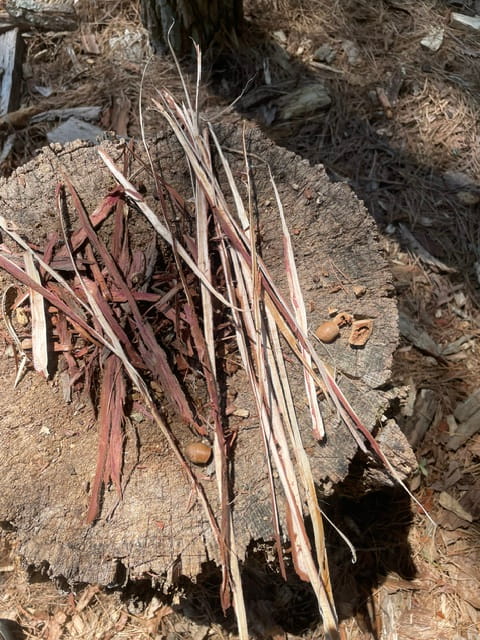
When you’re done stripping the outer and inner bark, you should have a bunch of strips that look like this:
These white inner strips of bark are close to ready to make cordage.
Now you’re going to want to split these strips until they are all roughly of the same width. The length can vary, because as you are about to see, you will be splicing fibers in as necessary. Length does not matter as long as the fibers, or bundles of fibers, are roughly the same diameter.
When you’re done your first round of processing, you should have some strips of white, inner, Atlantic White Cedar bark that are ready to wrap into cordage.
You will want to split your strips until they are all basically the same width.
Now it’s time to make that cordage. We’ll be using a method known as the “reverse wrap,” which, fortunately, could not be easier to execute.
Simply take a length of the bark fibers in your hand and start twisting the ends of the fibers. This is critical; make sure that you’re twisting each end in what is the apparent opposite direction. So if your right thumb is twisting the fibers upwards, your left thumb should be twisting them downwards.
Start twisting; at first, all you'll see is that the fibers are twisted but they won't have started to wrap themselves into a rope.
At, first, it will just look like you’re twisting some random fibers, but as you continue, the “rope” will start to form a curve, and then a loop, and will look something like this:
Keep going, and the rope will start to form.
Progress:
As you wrap, the length of the rope will grow.
Once you get near the end of the fibers you’re working on, you’re going to want to splice in some new fibers to keep the rope going. This is why it was so critical earlier that we made the bundles of fibers roughly the same diameter. If not, they won’t work well together.
Splicing in the fibers is relatively easy, although it is the hardest part of this process. Simply lay the new fiber alongside the one you’re twisting, and keep going. It’s a bit of a challenge, but eventually the fibers will bite and the existing strand will pull in the new one. After a few revolutions, it should hold tight:
When you run out of length with your first bundle of fibers, you will want to splice more in. Lay them alongside the first set of fibers and continue twisting until they are wrapped up in the cordage. Be persistent; it takes some getting used to but it will pay off.
Keep going, and eventually, you will see the length of rope start to form:
What your cordage should start to look like after you've been working it for a few minutes.
Splice in new fibers, or bundles of fibers, as needed, to keep your rope going. After a few iterations, here’s what I had:
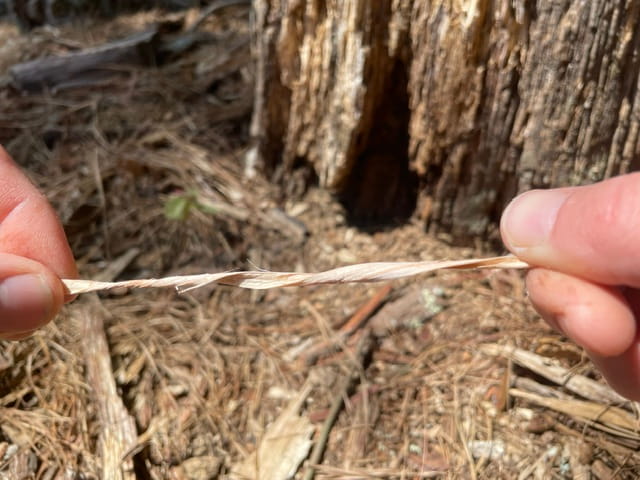
You can clearly see the "weave" of the rope in this image.
It’s a bit sloppy, because I did this in the yard in all of 20 minutes, from harvesting the raw bark to making the rope, but as you can see when I zoom in, the structure of the rope is there, and is very much like manufactured cordage.
Ultimately, you will want to make sure that your fibers are cleaned up and consistent in diameter before you start work, but even in a hurry, I was able to make some cordage using this reverse wrap technique, and you can too.
After you’re done, you can trim up any outstanding fibers, and admire your new creation, which you will find will be surprisingly strong.
The cool thing about this is you can use this reverse wrap method with basically any fibers you can find. You can use other plant fibers, strips of plastic bags, even animal hair (if it’s long enough, like horsehair) to make cordage using this technique.
So try it out and see what you can come up with. It’s immensely gratifying in camp to make your own cordage rather than needing to rely on what you can buy.