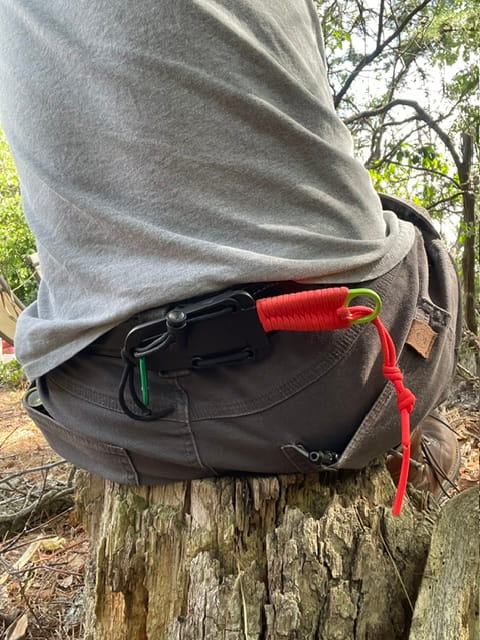
“Keep sharpening your knife and it will blunt.” ~Lao Tzu
There are some folk who won’t carry a fixed blade on the daily just because it’s some measure of inconvenient to them.
Granted, by and large, it is a lot more convenient to carry a folder. On top of that, you don’t need a sheath and you can carry a small folder fully inside a pocket, making it more discreet.
But there are trade offs, and they are material. Notably, there are things you can do with a fixed blade that you just can’t do with a folder, and on top of that, fixed blades are much, much lower on maintenance than folders.
As they say, any instance of design complexity is a potential opportunity for failure, and this is true here.
So, taking all of that into consideration, it’s a lot more convenient to carry a fixed blade not just when you have options, but when you know about that.
That being said, here are 10 ways to carry a fixed blade. There’s a whole world out there outside of tip-down on the belt and you’re about to discover it.
Tip-Down on the Belt
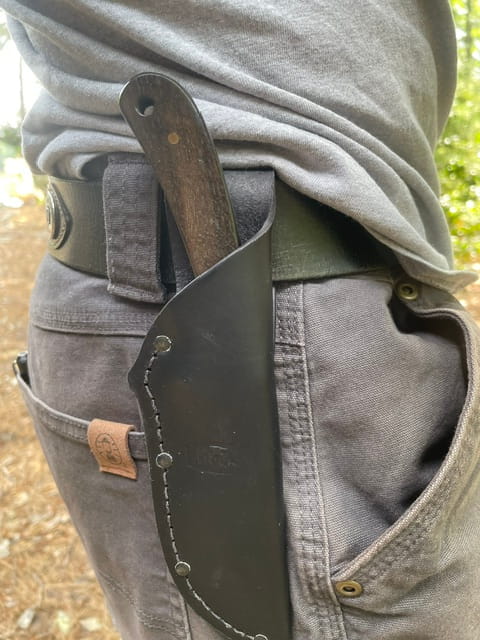
This is everyman’s bread and butter, and 99.9% of fixed blades are issued with sheaths that are ready-made for tip-down carry on the dominant side on a belt. Many are issued with sheaths, particularly leather sheaths, that only allow for this.
Here are some high-level advantages of this carry method:
Most sheaths are pre-rigged for this.
It’s intuitive to reach to this area for a knife.
It offers easy access and is amenable to fairly large knives.
But, with that said, there are some drawbacks to tip-down carry on the belt.
It doesn’t work if you’re not wearing a belt.
It’s not discreet.
While it does accommodate larger knives, it’s not very comfortable in a seating position. The knife will dig into your leg or contact the ground/your seat.
Tip-Up on the Belt
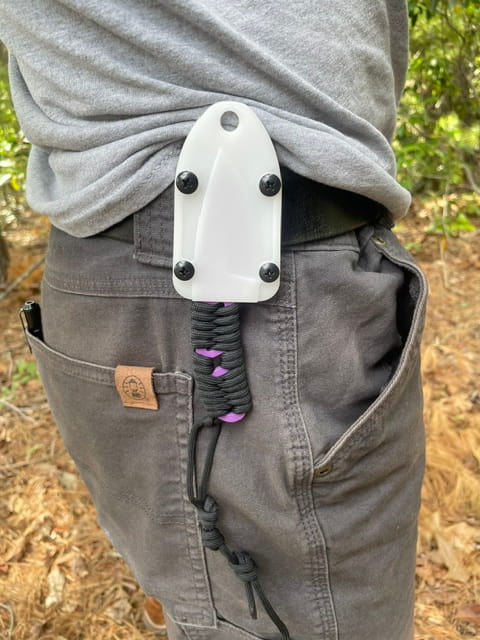
Tip-up carry on a belt is just a variant of tip-down and is generally practiced on the dominant side as well.
There are some advantages to this:
It’s convenient for smaller blades.
Some find it more comfortable to draw a blade down along the side rather than up.
And many drawbacks:
Tip-up on the belt does not work well with larger blades.
It’s a little harder to draw the knife.
Resheathing takes some practice.
You’ll need to rig the sheath for this, and many sheaths don’t offer this flexibility.
Pack or Shoulder Carry (Tip-Up)
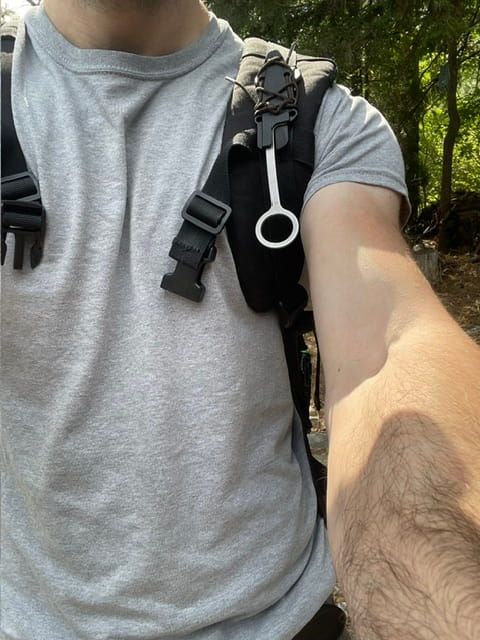
This is one of my favorite carry disciplines, especially when I am carrying a smaller knife, or when I am hunting or fishing. Pictured at the top is the Cold Steel Bird and Trout, which I carry on my non-dominant side, with the sheath lashed to a pack I carry when I am fishing in the spring.
Below is a Candiru that I carry when I am upland hunting in the fall. The sheath is clipped to a D-ring on my jacket, which, even though it isn’t a pack, I’m considering it the same carry method here.
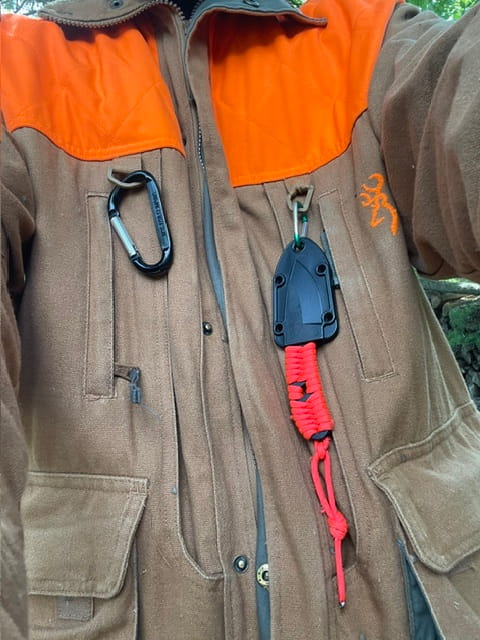
There are a lot of things I love about this carry method:
The knife is front and center, making it easy to draw.
It is even easier to draw from the non-dominant shoulder than from the hip.
It’s hard to access a belt when you’re wearing a jacket or a pack; this method solves that issue.
It works even if you aren’t wearing a belt.
It’s very convenient for smaller knives.
That said, there are a few disadvantages:
If you take your pack or jacket off, you’re now out of reach of your knife.
It’s not really practical with larger blades.
Other than that, there aren’t a lot of disadvantages to this carry method. It also works great with a second backup knife.
Static Line Carry
This is a method that I do not practice so I don’t have any pictures read, but basically what it is is a method of carrying in which you attach a short length of cordage to the tip-end of a sheath, then secure that to your belt or elsewhere on your person. When you draw the knife away from yourself the line tightens and the sheath pops off. It can be a convenient method with smaller blades and it’s possible to completely conceal small fixed blades in a pocket like this.
Here are some advantages to static line carry:
Total concealment is possible with smaller knives.
Drawing can be convenient and easy with good access.
At the same time:
It doesn’t work with larger knives.
Resheathing requires two hands.
All in all, thought I’m offering this as a practical option for carrying a fixed blade, it’s not one that I practice or see myself practicing at any point in the future.
Scout Carry
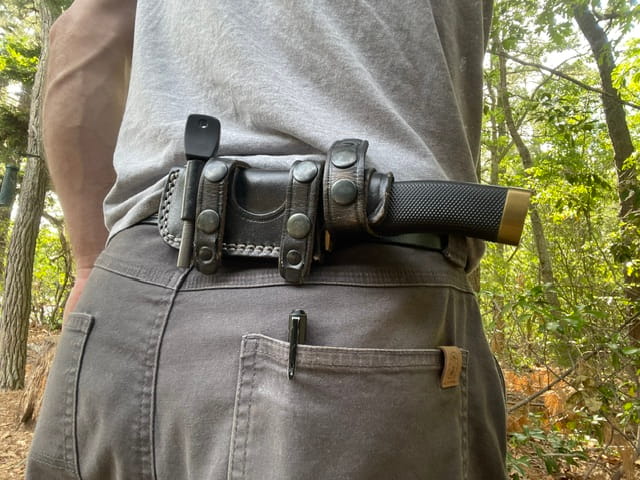
If I had to give up all other carry disciplines except one for the rest of all time, I’d sacrifice them all for scout carry.
This is, far and away, my favorite way to carry a fixed blade, and I’ve covered the benefits of scout carry at length before.
In scout carry, you carry the knife horizontally along your belt at the base of your spine, generally with the edge downward, with the point facing your non-dominant side. There are many benefits associated with this carry method:
It is practical with all but the largest knives.
With a small knife it will be completely concealed.
It is extremely discreet.
It’s very comfortable, even when seated, as the knife won’t dig into your leg.
Drawing from this position is intuitive.
As much as I love it, though, in the spirit of fairness there are some negatives:
Resheathing is difficult and requires a lot of attention.
If you’re laying down or against a wall, it’s difficult to draw from this position.
But, other than that, it’s a great carry method and one you should try if you never have.
Cross Draw
Cross draw is a carry method in which you carry the knife at an angle on your non-dominant side, sort of the way you’d carry a larger blade, like a sword. To draw it you have to cross your body, which gives the name.
This is another that I don’t really ever practice, but I could see the appeal. Some advantages are:
It’s good with larger knives.
It works if you’re carrying something on your dominant side, such as a pistol.
It’s comfortable, similar to scout carry.
As for shortcomings, there aren’t many. Personally I just don’t like it much, but otherwise, it’s comfortable and works with a lot of different types of blades.
Neck Carry
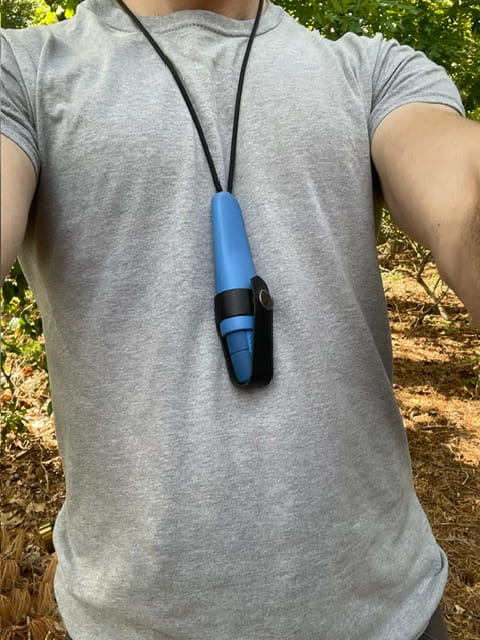
This is one I don’t routinely practice except when I am carrying my Eldris when I’m working on wooden something or other, and the only reason I do then is that there is no other comfortable way to carry an Eldris.
Anyway, neck carry is exactly what it sounds like. You carry the knife, suspended by the bottom of the sheath, via a cord around your neck. To draw it you pull away from the sheath. The knife must also be necessarily carried tip-up.
Some advantages of neck carry are that:
It keeps your belt unencumbered.
It allows for a user to draw using either hand.
It’s very discreet, with the right knife.
With that said, there are many drawbacks:
It’s not practical with larger knives.
You need a sheath that specifically allows for this method.
Resheathing requires two hands, generally.
If you’re wearing a lot of layers, it can be hard to access the knife.
Overall, it’s not a method I like to practice, but there are a lot of people who do. The only thing I can say is to try it and see if it works for you.
Boot Carry
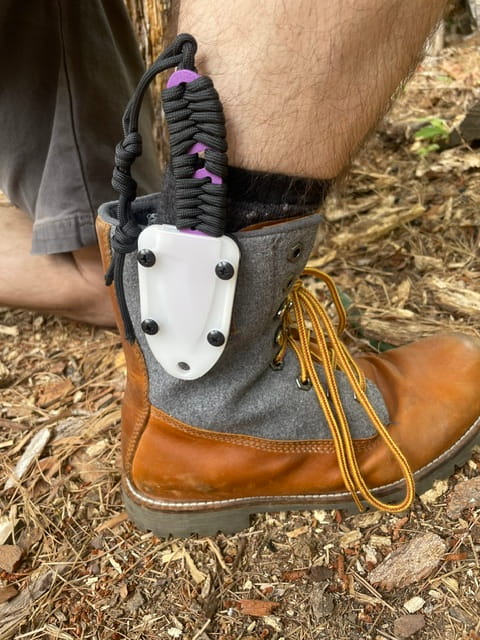
This is another one that I do not practice, but I might if I was strapped and needed to carry a second or third knife and my usual carry methods were already engaged.
There’s more than one way to boot carry; the two most common are tucked into the laces or tucked into the boot’s shaft, or alternatively, on the outside.
There are some advantages associated with boot carry:
It can be discreet with a smaller knife because no one will be expecting you to carry in that location.
It’s good as a backup.
However, from my perspective, it has a lot more disadvantages:
It’s not practical with a larger knife.
It’s not comfortable.
Access is difficult, and impossible from some positions.
It requires a special sheath for that application.
Again, this is not one I would practice left to my own devices, but it is still something to look into if you’re investigating options.
Appendix Carry
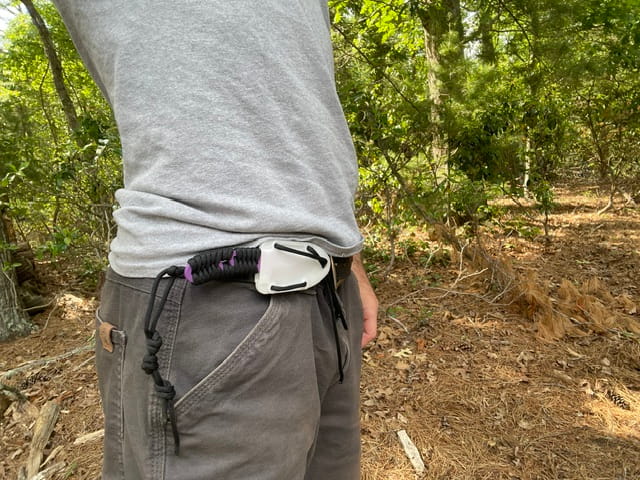
In appendix carry, you carry along your belt at the front of your body; it should be on your right side, but for a southpaw, it would be on the other side. It’s like scout carry except at the front of your body.
This is not a carry method I like but I recognize it has a lot of virtues:
Like scout carry, it is very discreet and can be practiced with relatively large blades.
Drawing is intuitive.
Since it is at the front of your body, you can see the sheath and resheathing is much easier, even with one hand.
Like scout carry, it is comfortable from basically any position, even when seated.
The shortcomings are few, there’s really only one I can think of:
If you’re laying on your stomach, it can be hard to draw.
Dangle Carry
Dangle carry is a variant of tip-down belt carry whereas instead of attaching your sheath directly to your belt, your sheath is attached to a separate loop for your belt via a ring. This ring lets the sheath swing freely, making it much more flexible and comfortable than standard tip-down carry on the belt.
Here are some advantages:
It’s a lot more comfortable for larger blades, since the knife can swing freely and won’t dig into you or the ground when you sit.
It lets the blade ride wherever it wants.
It’s highly practical with larger knives.
You can position the knife where you want.
For all the advantages of dangle carry, there is one big drawback:
Since the sheath swings freely, you generally need both hands not just to sheath the knife, but to draw it in the first place.
Other than that, dangle carry is both comfortable and practical, even with very large knives.
The Best Fixed Blade Carry Method Is the One You Like Best
There you have 10 of the most common ways to carry a fixed blade. As for me, I’m going to stick with scout carry and pack carry, as I have, but I’m not the be-all, end-all of this. You should experiment and see which works best for you. It wouldn’t do if we were all the same.
Stay sharp.
~The Eclectic Outfitter.