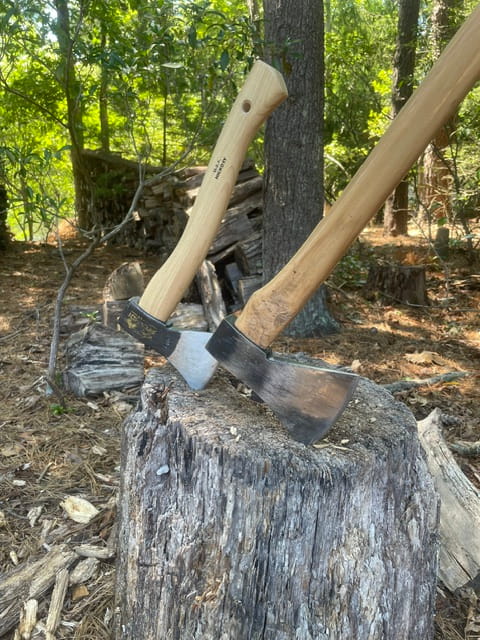
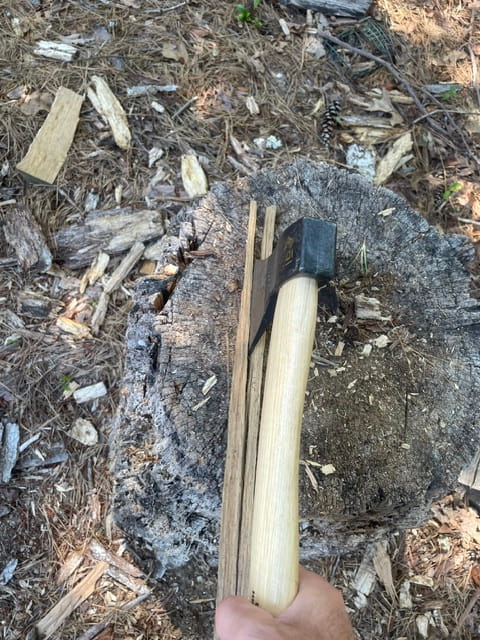
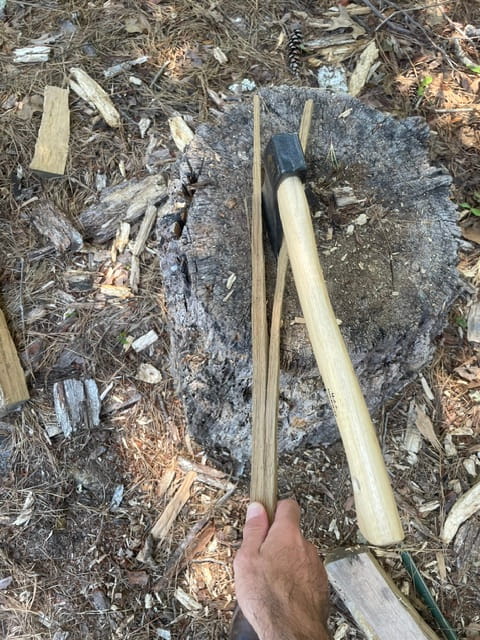
Axes are amazing tools that are incredibly versatile. Intended primarily as woodworking implements, an axe, in the hands of a skilled woodsman, can also be used as a striking tool for driving gluts and stakes, as well as a knife for cleaning and breaking down harvests.
Of course, there is more to the use of an axe than you might expect, so I started thinking over things I learned while wielding that I thought would have benefited me had I known them sooner.
Here they are.
How to Swing Powerfully and Accurately
I genuinely don’t remember where I read it, but at some point in life I read, somewhere online, that an axe should be swung, and I quote, like a baseball bat.
I wish I could find the source because it struck me as braindead then and even reflecting on it I’m getting secondhand embarrassment from the person that typed that out and then committed to posting it.
Swinging an axe like a baseball bat, with both hands low on the haft, is a sure-fire way to miss whatever you’re swinging at, not to mention it gives you no more power than the method I’m about to propose.
Whether you’re splitting by swinging the axe over your head, or making a crossgrain cut to fell a standing tree, your dominant hand should start by grasping the haft high up, almost just under the head.
When you swing, your dominant hand should slide down the haft of the axe, accelerating towards your non-dominant hand that grips it firmly and statically at the base of haft, where more often than not there is a swell.
This method drives power, control and accuracy, and is infinitely better than swinging the axe “like a bat”.
Please, don’t.
Crossgrain Cuts: A Quick Tip That Should Be Obvious
Forgive me if this is painfully obvious, but I fear that to anyone that has never actually swung an axe, it would be jarring to note that the bit, no matter how sharp it is, is actually painfully inadequate for making a square-on cut across the grain of any species of wood.
No matter how sharp your axe is, and how strong you are, if you swing your axe bit into wood so that the bit meets perpendicularly with the grain, you’re not going to bite very deep. In fact, most of the time the bit will bounce right back off of the wood and won’t even stick in.
Whenever you’re working across the grain of wood, primarily here for the purpose of felling, you want your bit to contact the grain at roughly a 45-degree angle. It will create shear forces that pull the grain apart as the bit digs in, and the bit will sink in much deeper with much less effort from you. On top of that, with the right angle, you have less of a chance of the bit bouncing off or glanding off the surface of the wood you intend to cut.
Splitting
One of the best tips I have for splitting a piece of wood is that you need to learn how to choose the right axe style and read the piece of wood you’re trying to split. I have a couple of notes here:
You should be using a maul, not a felling axe, for splitting.
If the wood is particularly knotty, don’t even waste your time with a maul. Go straight for sledge and wedge (or wedges).
If the grain is straight and the wood is not dense, like birch or pine, you might be able to get away with a felling axe. Plus, they’re lighter and easier to control.
Here’s another important tip. Unless you are splitting with a sledge and wedge, don’t try to split rounds that are directly on the ground. There are two good reasons I’m calling this out.
One is that, if you are successful, the bit of your axe will go right through the wood you’re splitting and into the ground. Trust me, you do not want this.
The other reason is that the ground is generally springy and has an infinite ability to absorb most of the force you are putting into your swing. In other words, if you split a round directly on the ground, you’re pissing strength away.
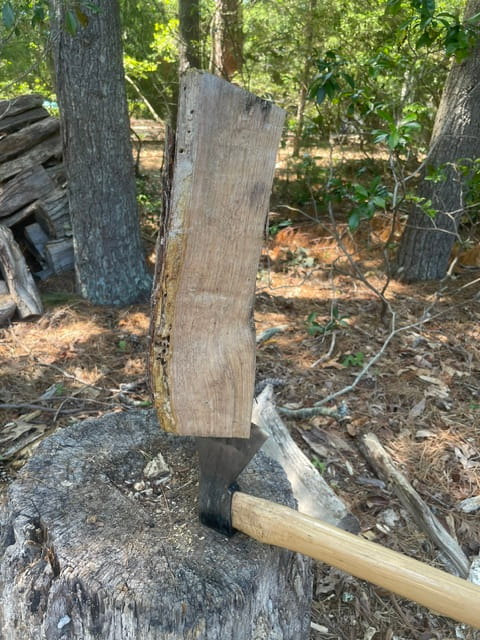
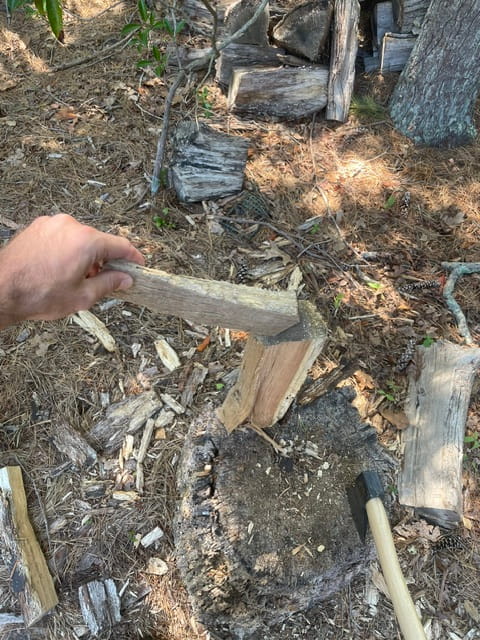
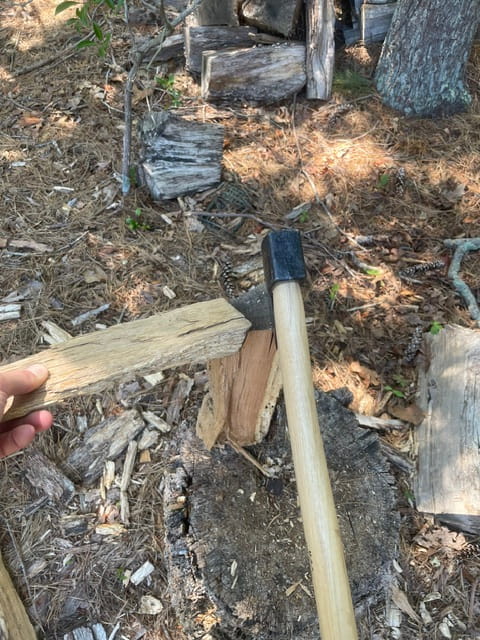
Set up a splitting block. Another round of wood works perfectly for this because it will direct most of the force of your swing right back into the piece you’re trying to split, which is exactly what you want.
Split Smarter, Not Harder