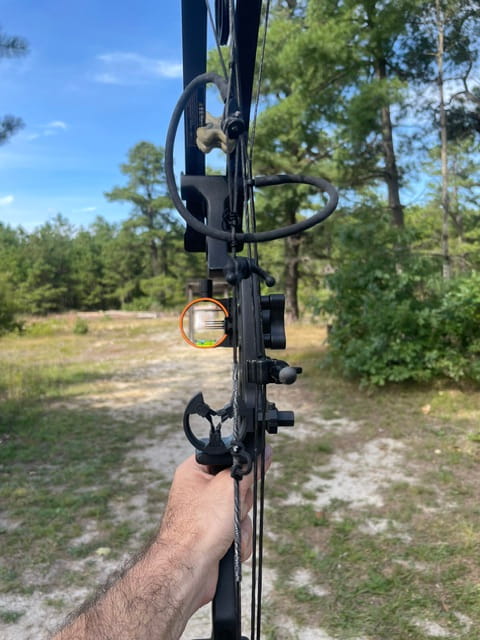
“Fletchers straighten the arrow shaft…the wise control themselves.” ~Dhammapada
Recently I was at the range dialing in my bow just before the beginning of fall bow season for deer here where I live, and it got me thinking about how sighting in a bow with a bow sight is a slightly different procedure than sighting in a gun.
With a gun, over iron sights, at least, what you do is fire off a group, see where they land, and then adjust the rear sight in the opposite apparent direction from where the group clustered.
So, for instance, if you shoot a group and it clustered high and to the right of your point of aim, what you would do is adjust the rear sight down and to the left, to bring your point of aim in line with the point of impact.
It’s the opposite with a bow. Here’s what you need to know.
The Criticality of a Consistent Anchor Point
First things first, with a compound bow, or any boy, really, there is no rear sight. Your dominant eye is functionally your rear sight. This can’t be adjusted.
It also brings into focus the reason that a consistent anchor point is literally critical if you are going to use a bow sight with your bow. Even with the highest-end bow sight in the world, if your anchor point is not consistent, your shots won’t be either.
Now, there are two ways to go about this. One is to install a peep sight, which I have on my bow. The other is to install a kisser button, or some other index that makes it easy for you to establish a consistent and replicable anchor point.
We’ll look at what I do, which is use a peep sight. The premise behind a peep sight is that there’s a little hole through the bow string that lines up with your dominant eye when you’re at full draw.
You look through the peep sight, over your (front) bow sight, and at the target. In this configuration, your eye, through the peep sight, is your rear sight, and creates a line by aligning with the front sight.
Since you can’t adjust your eye, you need to adjust your front sight, but to do that, first you need to fire a group of arrows and see where they land.
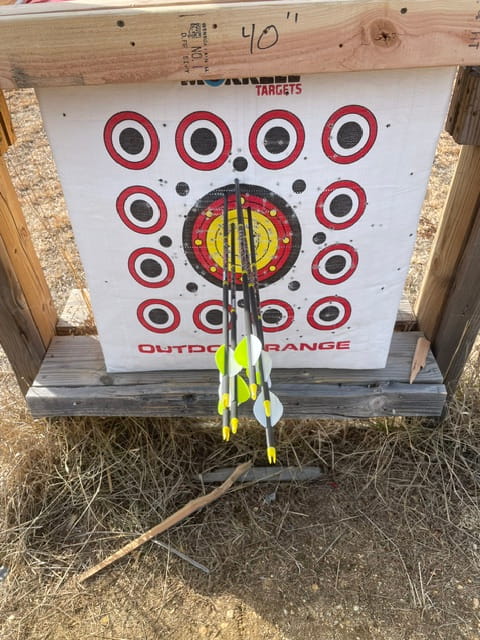
Shoot a Group of Three to Five Arrows
Just so you don’t lose any arrows, you should start the process of sight-in fairly close to the target. Let’s say 10 yards since there’s a good chance you won’t miss the target at this range.
Draw your bow, fire an arrow at a spot on the target, and take note of where it landed. If it hit the target, fire 2 to 4 more arrows, and see where they clustered.
If they all clustered in one tight group, you’re good to start adjusting your sights. If they didn’t, either you did something wrong, or your arrows are neither tuned to your bow or matched well to it, or both.
Adjust Your Front Sight
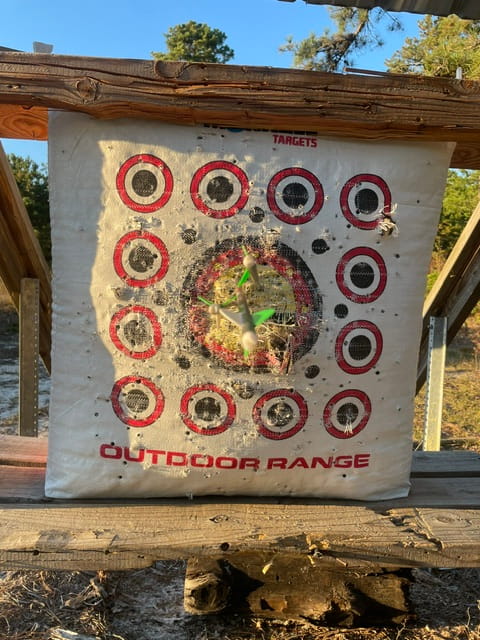
Once you have a tight group of arrows clustered on the target, what you want to do is adjust your bow sight so that the top pin moves towards the apparent point of impact rather than away from it.
So, let’s say your arrows went high and to the left. The first thing you should do is make an incremental adjustment to the left slightly, then fire 3 more arrows at that target.
Keep adjusting your bow sight over towards the left until the group is in line with where your bow sight is.
Once that’s done, adjust the pin upwards a small increment, then fire off another 3 to 5 arrows. Continue to adjust the pin upwards until it is in line with where the arrows are landing on the target.
Now, if your bow sight has additional pins (and almost all do) you can use the lower pins to sight in the bow at different ranges, but this is entirely optional. Some bow sights are one-pin sights and many hunters use them.
Either way, once you’re sighted in, you can fire off a few more groups and get back into the woods where it matters.
Shoot a Few More Groups, and That’s That
Ultimately, there’s a lot more that could be said about how to sight in a compound bow with a bow sight, but for the purposes of getting your bow more or less hunt-ready, this short tutorial should suffice.
You can into other more detailed considerations down the line. For now, if you can shoot 3 to 5 inch groups consistently at 10 yards, you’re good to take a deer at that range.
Be safe.
~The Eclectic Outfitter